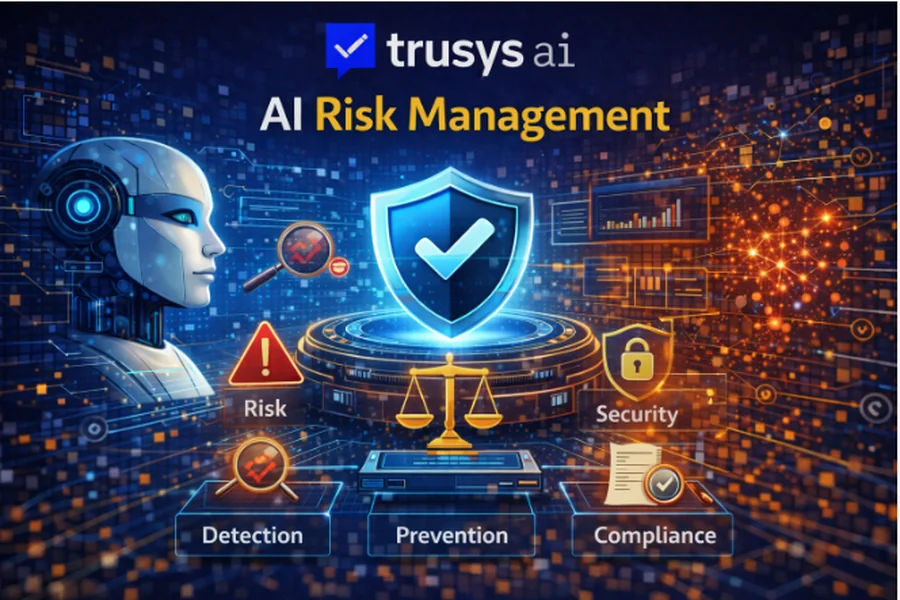
Trusys AI: AI Risk Management, Evaluation, and Governance in One Platform

Artificial intelligence is no longer experimental—it’s operational. According to McKinsey (2024), 65% of organizations now use AI in at least one core business function, and that number continues to rise. Meanwhile, the Stanford AI Index reports a 27% annual increase in AI-related incidents, and Gartner predicts that by 2026, more than 80% of enterprises will deploy generative AI applications in production.
However, rapid AI adoption has introduced a new wave of enterprise risk. From hallucinations and biased outputs to regulatory scrutiny and security vulnerabilities, AI systems now require structured oversight. This is why forward-thinking organizations are investing in AI risk management, AI evaluation, and AI governance—not as separate tools, but as an integrated strategy.
Trusys AI delivers exactly that: AI risk management, evaluation, and governance in one unified platform.
The Growing Enterprise AI Risk Landscape
AI systems operate at scale, which means errors scale too. Unlike traditional software, AI models evolve based on data inputs. Consequently, they introduce new types of risks:
- AI hallucinations generating inaccurate outputs
- Model drift reducing prediction accuracy over time
- Compliance violations under frameworks like the EU AI Act
- Security threats targeting AI pipelines
- Lack of transparency and accountability
IBM reports that the global average data breach cost reached $4.45 million, and AI-related vulnerabilities are becoming a growing contributor. Therefore, organizations must treat AI oversight as a strategic priority.
Why AI Risk Management Is No Longer Optional
AI risk management identifies, assesses, and mitigates potential failures before they escalate. Without structured AI risk management, enterprises operate blindly.
Effective AI risk management includes:
- Risk classification of AI models
- Identification of high-impact use cases
- Access control and role-based governance
- Continuous compliance mapping
- Executive-level visibility dashboards
According to BCG, organizations with formal governance frameworks are 2.4x more likely to achieve positive ROI from AI investments. Clearly, risk management strengthens—not slows—innovation.
AI Evaluation: The Foundation of Trustworthy AI
AI evaluation validates whether a model performs reliably across different scenarios. Yet many enterprises rely on limited pre-deployment testing and ignore post-deployment performance.
AI evaluation should include:
- Functional QA testing for text, voice, and vision models
- Bias and fairness assessments
- Stress testing and adversarial validation
- Benchmark comparisons
- Continuous performance tracking
Research indicates that hallucination rates in uncontrolled LLM environments can range between 15–20%, underscoring the importance of structured evaluation. When organizations embed evaluation into development workflows, they reduce failure rates and improve confidence.
AI Governance: From Policy to Practice
AI governance translates Responsible AI principles into enforceable policies. However, governance often remains theoretical unless organizations implement real-time oversight mechanisms.
Effective AI governance requires:
- Clear documentation and accountability
- Alignment with standards like NIST AI RMF
- Audit-ready reporting
- Transparent monitoring systems
Gartner predicts that by 2027, 80% of enterprises will require formal AI governance platforms to operate across regulated markets. Companies that prepare now will gain a competitive advantage.
The Problem with Fragmented AI Tools
Many enterprises use separate tools for security, monitoring, and testing. While each tool solves a specific problem, the lack of integration creates blind spots.
Fragmented systems lead to:
- Inconsistent reporting
- Delayed issue detection
- Compliance gaps
- Increased operational overhead
Therefore, organizations need a unified solution that connects risk management, evaluation, and governance into a single workflow.
How Trusys AI Brings It All Together
Trusys AI eliminates silos by delivering a comprehensive AI assurance platform.
1. Centralized AI Risk Management
Trusys enables organizations to identify and classify AI risks systematically. It provides governance dashboards that offer leadership clear visibility into AI operations.
As a result, enterprises proactively manage vulnerabilities instead of reacting to crises.
2. Built-In AI Evaluation
Trusys integrates functional QA testing and performance validation directly into the AI lifecycle. This approach ensures that models undergo structured evaluation before deployment and continuous validation afterward.
Consequently, enterprises reduce hallucinations, improve accuracy, and maintain reliability.
3. Real-Time Monitoring and Governance
Trusys provides continuous monitoring that detects drift, anomalies, and usage deviations in real time. Additionally, it aligns AI systems with global governance standards, ensuring regulatory readiness.
By unifying oversight, Trusys transforms governance from a compliance burden into an operational advantage.
Business Impact of a Unified AI Platform
When enterprises adopt a single AI risk management and governance platform, they experience measurable improvements:
Reduced Regulatory Risk
Proactive compliance mapping minimizes exposure to penalties and audits.
Improved Model Reliability
Continuous evaluation ensures performance stability across changing datasets.
Enhanced Stakeholder Trust
Transparent oversight builds confidence among customers and regulators.
Operational Efficiency
Centralized reporting reduces administrative overhead and accelerates decision-making.
Organizations that integrate governance early avoid costly retroactive fixes later.
Responsible AI as a Competitive Advantage
Responsible AI goes beyond avoiding penalties. It enhances brand reputation and strengthens long-term strategy.
Enterprises that embed Responsible AI principles demonstrate:
- Ethical accountability
- Transparent decision-making
- Commitment to fairness
- Data security resilience
Deloitte reports that trust-driven organizations outperform peers in customer retention and revenue growth. Therefore, governance directly contributes to market differentiation.
The Future of AI Assurance
AI adoption will only accelerate. As automation expands into high-stakes domains such as healthcare, finance, and public services, oversight expectations will intensify.
The future of AI belongs to organizations that combine innovation with structured accountability. AI risk management, evaluation, and governance must operate seamlessly—not separately.
Trusys AI positions enterprises for this future by delivering unified oversight in one scalable platform.
A Smarter Way to Scale AI
Managing AI complexity does not require more tools—it requires better integration. By consolidating AI risk management, evaluation, and governance into a single solution, enterprises gain clarity, control, and confidence.
Trusys AI empowers organizations to deploy AI responsibly while maintaining agility. Instead of reacting to failures, leaders proactively safeguard performance, compliance, and trust.
AI innovation thrives when oversight works. With Trusys AI, enterprises no longer choose between speed and safety—they achieve both.
FAQs
1. What is AI risk management?
AI risk management identifies and mitigates potential failures in AI systems to reduce operational, financial, and compliance risks.
2. Why is AI evaluation important?
AI evaluation ensures models perform accurately and fairly before and after deployment.
3. How does AI governance support compliance?
AI governance aligns AI systems with regulatory standards and provides audit-ready documentation.
4. What makes Trusys AI different?
Trusys integrates risk management, evaluation, and governance into one unified AI assurance platform.
5. Can a unified platform reduce AI project failures?
Yes. Integrated oversight reduces blind spots, improves monitoring, and lowers deployment risks.