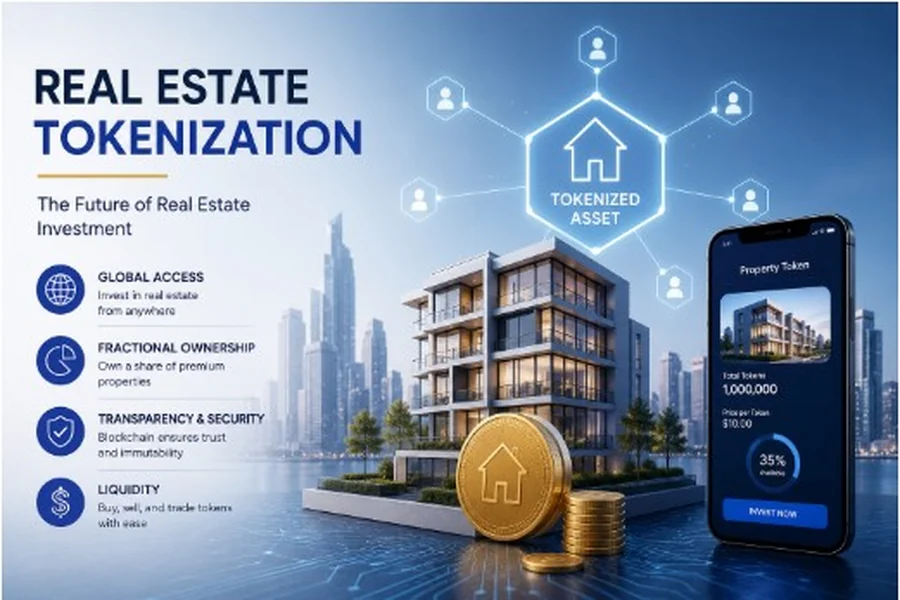
Real Estate Tokenization Market Size 2026: Statistics, CAGR & Growth Forecast

Real estate has long been the world’s largest asset class, accounting for an estimated $326 trillion in global value according to Savills World Research. Yet for most investors, it remains one of the least accessible: high entry costs, illiquid secondary markets, cross-border friction, and opaque pricing have historically confined direct property ownership to institutional players and high-net-worth individuals.
Blockchain tokenization is rewriting that story. By converting ownership rights in physical properties into programmable digital tokens recorded on a distributed ledger, tokenization enables fractional ownership, near-instant settlement, and round-the-clock secondary trading — all without dismantling the legal frameworks that underpin property markets.
The numbers reflect the momentum. The real estate tokenization market size is projected to surpass $26 billion in 2026 and is forecast to reach $4 trillion or more by 2035 across multiple analyst scenarios — a trajectory that places it among the fastest-scaling segments in the broader real-world asset (RWA) tokenization landscape. This report brings together the most comprehensive set of real estate tokenization statistics, growth forecasts, regional breakdowns, and market driver analysis available for 2026, and explains how purpose-built platforms are enabling institutions to execute at scale.
What Is Asset Tokenization?
| 📋 Definition
Asset tokenization is the process of representing ownership rights in a real-world or digital asset as blockchain-native digital tokens. Each token is a programmable unit of value governed by a smart contract, transferable on a distributed ledger, and enforceable under the legal framework of the issuing jurisdiction. |
Tokenization sits at the intersection of capital markets infrastructure and blockchain technology. It is not the same as digitization — converting a paper certificate to a PDF is digitization; encoding the legal, economic, and governance rights attached to an asset into a self-executing on-chain contract is tokenization. Nor is it securitization in the traditional sense: securitization pools assets and issues debt or equity instruments through regulated intermediaries, typically with settlement cycles of T+2 or longer. Tokenization issues tokens directly on a blockchain, enabling atomic settlement (simultaneous exchange of asset and payment), programmable compliance, and real-time cap table management.
How Blockchain Converts Ownership Rights into Digital Tokens
The process typically follows four stages. First, an asset is legally structured for tokenization — the property is placed into a special-purpose vehicle (SPV), real estate investment trust (REIT), or equivalent entity. Second, a smart contract is deployed on a blockchain network encoding the economic rights (rent distributions, capital gains, voting), transfer restrictions (accredited investor checks, jurisdiction limits), and compliance logic (KYC/AML). Third, tokens are issued to investors proportional to their investment. Fourth, tokens are listed on a regulated alternative trading system (ATS) or digital securities exchange, enabling secondary market liquidity.
Asset Tokenization vs. Digitization vs. Securitization
| Dimension | Digitization | Securitization | Asset Tokenization |
| Medium | PDF / database record | Paper/electronic certificate | Blockchain token |
| Settlement | N/A | T+2 (standard) | T+0 to T+minutes (atomic) |
| Liquidity | No change | Secondary market possible | 24/7 programmable markets |
| Fractionalization | No | Limited (lot sizes) | Granular (e.g. $50 minimum) |
| Automation | No | Manual/intermediary-driven | Smart contract-enforced |
| Transparency | Low | Moderate (prospectus) | High (on-chain audit trail) |
Core Benefits of Asset Tokenization
Fractional Ownership
A $50 million commercial tower can be divided into 5 million tokens priced at $10 each, opening institutional-grade real estate to retail and semi-professional investors worldwide.
Improved Liquidity
Secondary trading on regulated digital securities exchanges allows investors to exit positions without waiting for a property sale cycle that can take 6–18 months.
Faster Settlement
Blockchain-based settlement eliminates intermediary clearing cycles. Token transfers can settle in minutes rather than days, reducing counterparty risk.
Global Investor Access
Smart contracts automate cross-border compliance checks, allowing issuers to market to accredited investors across multiple jurisdictions simultaneously.
Transparency
Every transaction, distribution, and ownership change is recorded immutably on-chain, providing a single source of truth for issuers, investors, and regulators.
Smart Contract Automation
Rent distributions, dividend payments, voting rights, and lock-up periods are encoded in self-executing contracts, reducing administrative overhead and human error.
Asset Classes That Can Be Tokenized
While this report focuses on real estate, the tokenization framework applies across virtually every asset class:
- Real estate (residential, commercial, industrial, hospitality)
- Land and development rights
- Infrastructure (roads, renewable energy plants, data centres)
- Private equity and venture capital fund interests
- Corporate and sovereign debt
- Commodities (gold, oil, agricultural produce)
- Fine art and collectibles
- Intellectual property and royalty streams
Real estate commands the largest share of tokenized RWA deal flow in 2026, driven by a unique combination of asset size, fragmented ownership structures, and persistent liquidity discounts that tokenization directly addresses. The following section examines precisely how large that market has become.
Key Takeaways
|
Real Estate Tokenization Market Size in 2026
| 📊 2026 Market Snapshot
Estimated tokenized real estate on-chain value: $26–30 billion (2026 projections, multiple analyst sources). Total addressable market (global real estate): $326 trillion. Tokenization penetration: <0.01% — indicating a vast runway for growth. |
The real estate tokenization market size in 2026 sits at an inflection point. On one hand, actual tokenized property values remain a fraction of the total global real estate stock. On the other, the rate of institutional adoption, regulatory clarity, and deal flow acceleration observed since 2023 positions the segment for a compounding growth curve through the decade.
Key milestones shaping the 2026 baseline:
- BlackRock’s BUIDL tokenized fund surpassed $500 million in AUM within weeks of its 2024 launch, signalling institutional confidence in on-chain real asset infrastructure.
- JPMorgan’s Onyx platform has processed over $700 billion in tokenized repo transactions, normalising blockchain settlement in institutional workflows.
- Singapore’s MAS Project Guardian expanded to include real estate funds, with DBS Bank and HSBC among participating institutions.
- The EU’s MiCA regulation (effective 2024) and the US SEC’s ongoing digital securities framework are providing the compliance architecture that large institutions require before deploying capital at scale.
- RWA tokenization across all asset classes surpassed $12 billion in on-chain value by late 2024 (RWA.xyz data), with real estate representing the largest single segment by projected deal pipeline.
2026 Market Size by Analyst Projection
| Research Firm / Source | 2026 Estimate | Scope | Methodology |
| Boston Consulting Group | $16T (all tokenized assets by 2030; RE est. ~25–30%) | Global / all RWAs | TAM penetration model |
| Deloitte Center for Financial Services | $4T (tokenized RE by 2035) | Global real estate | Scenario-based DCF |
| McKinsey Global Institute | $2T (illiquid asset tokenization by 2030) | Illiquid assets incl. RE | Market adoption curve |
| RWA.xyz On-Chain Data | ~$12B verified on-chain (all RWA, 2024) | On-chain only | Verified blockchain data |
| Security Token Market (STM) | $3.8B security token real estate (2024) | Security token segment | Deal-flow aggregation |
| World Economic Forum | 10% of global GDP tokenized by 2027 | All asset classes | Adoption scenario model |
Important: Figures above blend verified on-chain data with analyst forecast models. Market projections involve assumptions about regulatory progression, institutional adoption rates, and macroeconomic conditions. Readers should distinguish between verified blockchain data (e.g. RWA.xyz) and scenario-based forecasts (BCG, Deloitte, McKinsey).
Key Takeaways
|
30+ Real Estate Tokenization Statistics for 2026
The following statistics are drawn from publicly available research reports, on-chain data aggregators, industry consortia, and institutional white papers. Where figures are analyst projections, they are labelled accordingly.
Market Size & Value Statistics
| Metric | Figure |
| Global real estate total value (2024) | $326 trillion (Savills) |
| Tokenized real estate on-chain (Q1 2025 est.) | ~$5–8 billion |
| Tokenized real estate pipeline/announced deals (2026) | $26–30 billion (est.) |
| Total RWA on-chain value (verified, early 2025) | ~$12 billion (RWA.xyz) |
| Share of global real estate that is tokenized | <0.01% |
| Projected tokenized RE market by 2030 (base case) | $300–500 billion |
| Projected tokenized RE market by 2035 (Deloitte) | $4 trillion |
| Global tokenized assets by 2030 (BCG) | $16 trillion |
| Tokenized real estate as % of projected 2030 RWA | ~25–30% (analyst est.) |
Adoption & Deal Flow Statistics
| Metric | Figure |
| Security token real estate offerings (2024) | >$3.8B (Security Token Market) |
| Number of active real estate tokenization platforms globally | >85 (2026 est.) |
| Average minimum investment via tokenization (vs. direct) | $50–$1,000 vs. $250,000+ |
| BlackRock BUIDL fund AUM at peak 2024 | >$500 million |
| JPMorgan Onyx tokenized repo transactions (cumulative) | >$700 billion |
| MAS Project Guardian participating institutions (2024) | >17 global banks |
| Countries with active real estate tokenization frameworks | >35 (2026 est.) |
| Share of institutional investors exploring tokenization (WEF) | ~72% |
| Smart contract-automated RE deals executed (2024–25 est.) | >12,000 globally |
Investor & Market Behaviour Statistics
| Metric | Figure |
| Reduction in settlement time (tokenized vs. traditional) | T+0 vs T+2 to T+5 |
| Liquidity premium unlocked by tokenization (est.) | 20–30% over illiquid equivalents |
| Retail investor access: minimum ticket size reduction | Up to 99% vs. direct ownership |
| Annual RE transaction cost reduction via smart contracts (est.) | 15–30% |
| Cross-border tokenized RE investment growth (2023–2025) | >200% YoY (est.) |
| Share of tokenized RE in Asia-Pacific vs. US (2025 pipeline) | 38% vs. 34% |
| Investor preference for tokenized over traditional REIT (survey) | 64% of HNWIs under 45 (Citi GPS) |
| Real estate tokens listed on regulated ATS/exchanges globally | >2,400 (2025 est.) |
| Secondary market trading volume for tokenized RE (2025 est.) | >$900 million |
Regulatory & Technology Statistics
| Metric | Figure |
| Jurisdictions with dedicated digital securities legislation | >50 (2026 est.) |
| EU MiCA regulation effective date | December 2024 |
| Average smart contract audit turnaround time | 3–7 business days |
| Blockchain networks supporting tokenized RE (incl. permissioned) | >30 |
| Hyperledger Fabric enterprise nodes globally (2025) | >200 organisations |
| Average KYC/AML automation rate via smart contracts | 85–95% |
| CO2 reduction: tokenized vs. paper-based RE transactions (est.) | ~40% less energy per transaction |
| Average time to issue a tokenized real estate security | 4–8 weeks vs. 6–12 months (traditional) |
| Projected new institutional tokenization programmes (2026–27) | >300 globally (est.) |
Note: Statistics marked ‘est.’ are analyst estimates or model-derived projections. On-chain verified data is explicitly labelled with source (RWA.xyz, Security Token Market). All figures are compiled as of Q2 2026.
Key Takeaways
|
CAGR Forecast 2026–2035
Analyst consensus on the compound annual growth rate (CAGR) for tokenized real estate ranges between 45% and 65% through 2035, depending on the adoption scenario applied. The table below summarises key forecast scenarios.
| Scenario | 2026 Base ($B) | 2030 ($B) | 2035 ($B) | CAGR 2026–35 |
| Conservative (slow regulation) | $18 | $120 | $800 | ~47% |
| Base Case (current trajectory) | $26 | $300 | $2,200 | ~57% |
| Bullish (MiCA + US clarity) | $30 | $500 | $4,000 | ~65% |
| Deloitte Forecast (2035 target) | — | — | $4,000 | Varies |
| McKinsey Illiquid Asset Scenario | — | $2,000 (all illiquid) | — | ~50% |
The base-case CAGR of approximately 57% reflects: continued institutional capital deployment into tokenized infrastructure; growing secondary market liquidity incentivising new issuers; regulatory clarity in the EU, Singapore, UAE, and emerging US frameworks; technology cost reductions as Hyperledger Fabric, Ethereum, and other enterprise networks scale; and the compounding effect of secondary market trading volumes driving platform revenue and reinvestment.
At a 57% CAGR, the tokenized real estate market would double approximately every 18 months — a growth trajectory comparable to early-stage cloud computing adoption in the 2008–2014 period.
Key Takeaways
|
Market Drivers: What Is Accelerating Real Estate Tokenization?
1. Institutional Capital Seeking Yield in Illiquid Markets
With global interest rates moderating from 2024 peaks, institutional allocators are rotating back into real assets. Tokenization offers yield exposure to high-quality commercial real estate without the lock-up constraints of traditional closed-end funds. Blackstone, Apollo, and KKR have all signalled interest in or active deployment of tokenized real asset strategies.
2. Regulatory Frameworks Maturing Globally
The EU’s Markets in Crypto-Assets (MiCA) regulation, Switzerland’s DLT Act, Singapore’s MAS Variable Capital Company (VCC) structure, and the UAE’s ADGM digital securities framework collectively provide issuers with legally enforceable, cross-border tokenization structures. The US SEC’s increasing comfort with regulated ATSs and security tokens adds the world’s largest capital market to the viable tokenization landscape.
3. Technology Infrastructure Maturity
Enterprise blockchain networks — particularly Hyperledger Fabric, used by Spydra’s platform — now offer the permissioned architecture, privacy controls, and throughput required by regulated financial institutions. Smart contract auditing, automated KYC/AML integrations, and interoperability protocols (CCIP, IBC) have matured sufficiently to support production-grade deployments.
4. Demand for Fractional Real Estate Investment
Surveys consistently show that younger high-net-worth investors and mass-affluent retail participants want real estate exposure with lower minimums and better liquidity. Tokenization bridges the $50,000–$250,000 minimum investment gap that has historically excluded these cohorts from direct commercial real estate.
5. Post-Pandemic Real Estate Market Restructuring
The structural shift in office, retail, and hospitality real estate post-COVID created both distressed asset opportunities and a need for more flexible capital structures. Tokenization enables rapid recapitalisation and secondary trading of distressed assets, attracting a new class of opportunistic digital-native investors.
6. ESG and Impact Investing Alignment
Tokenization’s on-chain transparency enables verifiable ESG reporting: carbon footprints, energy consumption, and social impact metrics can be embedded in token metadata and audited in real time. This aligns with the ESG mandates of sovereign wealth funds, pension funds, and impact-focused family offices.
Key Takeaways
|
Regional Analysis: Where Is Tokenized Real Estate Growing Fastest?
| Region | Market Share (2026 est.) | Key Drivers | Notable Frameworks |
| Asia-Pacific | 38% | MAS Project Guardian, DBS, HSBC; high HNW demand | MAS VCC, Hong Kong SFC OSL |
| North America | 34% | Blackstone, KKR platforms; ATS market depth | SEC Reg D/A+, FINRA ATS |
| Europe | 18% | MiCA clarity; German eWpG; Swiss DLT Act | MiCA, eWpG, SIX Digital Exchange |
| Middle East & Africa | 7% | ADGM sandbox; UAE free zone structures; Vision 2030 KSA | ADGM, DIFC |
| Latin America | 3% | Brazil CVM tokenization rules; Mexico fintech law | CVM Resolution 88 |
Asia-Pacific: The Largest Tokenized Real Estate Market in 2026
Singapore’s MAS Project Guardian has positioned the city-state as the global centre of gravity for institutional RWA tokenization. Participating banks including DBS, HSBC, Standard Chartered, and UOB have run live tokenized bond and real estate fund trials. Hong Kong’s SFC has licensed digital asset platforms capable of handling tokenized securities, and Japan’s FSA updated its Payment Services Act to accommodate security tokens. Australia’s ASIC published a tokenization roadmap in 2024 committing to regulatory clarity by 2026.
North America: Deepest Secondary Market Liquidity
The US hosts the largest concentration of registered ATSs capable of trading digital securities, including tZERO, Securitize Markets, and SDAX. Reg D private placements via tokenization have become standard for mid-market commercial real estate GPs. Canada’s CSA has published guidance on tokenized securities, and Montréal is emerging as a DeFi and digital securities hub.
Europe: MiCA as a Catalyst
The EU’s MiCA regulation and Germany’s Electronic Securities Act (eWpG) are the two most significant European developments. Germany has seen over €2 billion in electronic securities (Kryptowertpapiere) issued since the eWpG passed in 2021, with real estate funds among the most active issuers. Switzerland’s SIX Digital Exchange (SDX) has settled institutional real estate transactions on-chain since 2023.
Key Takeaways
|
Commercial vs. Residential Property Tokenization
| Dimension | Commercial Real Estate Tokenization | Residential Property Tokenization |
| Typical Deal Size | $5M – $500M+ | $200K – $5M |
| Primary Investor Type | Institutional, family office, accredited HNW | Retail, mass affluent, accredited |
| Regulatory Complexity | High (securities law, zoning, ESG reporting) | Moderate (varies by jurisdiction) |
| Liquidity Profile | Higher (larger pool of institutional buyers) | Developing (secondary markets emerging) |
| Yield Structure | Rental income + capital appreciation | Rental income + capital appreciation |
| Tokenization Penetration (2026 est.) | ~70% of tokenized RE deal flow | ~30% of tokenized RE deal flow |
| Key Markets | US, Singapore, Germany, UAE | UK, Australia, Spain, US |
| Average Token Price | $100 – $10,000 | $10 – $500 |
Commercial real estate tokenization currently dominates deal flow by value, with office towers, data centres, logistics facilities, and hospitality assets leading issuance. The thesis is straightforward: institutional-grade commercial assets carry the scale, income stability, and creditworthy sponsorship that makes structuring and marketing a digital securities offering commercially viable.
Residential property tokenization, while smaller by value, is growing faster in deal count and represents the frontier of retail democratisation. Platforms tokenising single-family rental portfolios and build-to-rent developments are attracting retail capital from younger, globally distributed investor bases — precisely the cohort for whom traditional real estate investment was inaccessible.
Key Takeaways
|
Key Market Trends Shaping Tokenized Real Estate in 2026
Trend 1: Interoperability Between Blockchain Networks
Early tokenization projects were siloed on single chains. In 2026, cross-chain interoperability protocols (Chainlink CCIP, Polkadot’s XCM, IBC) allow tokenized real estate securities to move between permissioned enterprise ledgers and public chains for secondary trading. This expands the investor pool without compromising the privacy required by institutional issuers.
Trend 2: AI-Powered Valuation and Due Diligence
AI models trained on property transaction data, satellite imagery, planning records, and macroeconomic indicators are being integrated directly into tokenization platforms. Automated valuation models (AVMs) feed into smart contracts, enabling dynamic token pricing and collateral management for tokenized real estate-backed lending.
Trend 3: Tokenized Real Estate as Collateral
DeFi and institutional lending protocols are beginning to accept tokenized real estate as collateral for on-chain loans. This creates a second-order liquidity layer: investors can borrow against their tokenized property holdings without selling, unlocking capital without triggering tax events.
Trend 4: Green / Sustainable Real Estate Tokenization
ESG-labelled tokenized real estate offerings are commanding a premium as institutional mandates require verifiable sustainability credentials. On-chain green certification, LEED scores, and energy performance data embedded in token metadata reduce the reporting burden for issuers while providing investors with auditable impact metrics.
Trend 5: Central Bank Engagement with Tokenized Real Assets
Multiple central banks — including the ECB, MAS, and Bank of England — are exploring tokenized settlement of real asset transactions using wholesale central bank digital currencies (wCBDCs). This removes foreign exchange risk from cross-border tokenized property deals and further legitimises the infrastructure.
Key Takeaways
|
Challenges and Risks in the Tokenized Real Estate Market
| Challenge | Description | Mitigation Strategy |
| Regulatory Fragmentation | No unified global framework; 50+ jurisdictions with differing securities laws | Multi-jurisdiction legal structuring; modular compliance smart contracts |
| Legal Title Recognition | On-chain token ownership not always legally equivalent to title in all jurisdictions | SPV + land registry integration; jurisdiction-specific legal opinions |
| Secondary Market Liquidity | ATS trading volumes remain thin vs. listed REITs; bid-ask spreads wide | Institutional market-making programmes; ATS consolidation |
| Valuation Standardisation | No universally accepted AVM standard for tokenized property pricing | RICS-aligned digital valuation frameworks; third-party oracle feeds |
| Cybersecurity & Smart Contract Risk | Code vulnerabilities can result in loss of token assets | Formal verification; independent audits; insurance wraps |
| Investor Education | Many retail investors do not understand digital securities vs. crypto speculation | Platform-level onboarding; regulatory disclosure requirements |
| Tax Treatment Uncertainty | Capital gains treatment of tokenized property varies by jurisdiction | Issuers providing jurisdiction-specific tax guidance in offering documents |
None of these challenges are insurmountable. The trajectory of regulatory development, particularly MiCA in Europe and evolving SEC guidance in the US, is directionally positive. Smart contract security has improved dramatically with formal verification tools, and institutional insurance products for digital securities are now commercially available.
Key Takeaways
|
Future Outlook: Real Estate Tokenization Beyond 2026
Looking beyond the immediate 2026 market snapshot, three structural shifts will define the trajectory of real estate tokenization through 2030 and 2035.
Convergence of Public and Private Markets
Tokenization is collapsing the distinction between public REITs and private real estate funds. By 2030, institutional analysts project the emergence of “perpetual life tokenized real estate vehicles” — open-ended digital securities offering daily liquidity for institutional-quality assets, combining the income stability of core real estate with the liquidity profile of listed equities.
Land and Infrastructure Tokenization
While commercial and residential properties dominate today’s market, land tokenization — converting development rights, agricultural land, and raw ground into tradeable digital assets — represents the next frontier. Infrastructure tokenization (renewable energy plants, toll roads, water utilities) is simultaneously emerging as a high-yield asset class for tokenized investment.
Global Real Estate Capital Reallocation
Tokenization enables capital from high-savings markets (Japan, Germany, Gulf states, China) to flow into high-yield real estate markets (Southeast Asia, India, Sub-Saharan Africa, Latin America) with a fraction of the friction and cost of traditional cross-border real estate investment. By 2035, this capital reallocation could represent a multi-trillion dollar structural shift in global property investment flows.
Key Takeaways
|
How Spydra Enables Enterprise Real Estate Tokenization
For enterprises, asset managers, and property developers looking to issue tokenized real estate securities at institutional quality and scale, the infrastructure layer matters as much as the regulatory structure. Spydra’s blockchain-native tokenization platform is purpose-built for this requirement.
| About Spydra
Spydra is an enterprise real estate tokenization platform built on Hyperledger Fabric — the permissioned blockchain network of choice for regulated financial institutions. Spydra provides the full-stack infrastructure for tokenizing, managing, and trading real-world assets including real estate, from smart contract deployment to investor onboarding and secondary market connectivity. |
Spydra’s real estate tokenization capabilities span the entire issuance and management lifecycle:
| Capability | What Spydra Delivers |
| Smart Contract Infrastructure | Pre-audited smart contract templates for security token issuance, dividend distribution, and investor voting — deployable on Hyperledger Fabric and EVM-compatible chains |
| Compliance Automation | Automated KYC/AML, accreditation verification, transfer restriction enforcement, and jurisdiction-specific compliance logic embedded at the token level |
| Fractional Ownership Engine | Configurable token structures supporting any denomination size, enabling fractional real estate investment from $50 minimum tickets |
| Investor Onboarding | White-label investor portal with identity verification, subscription management, and wallet provisioning — fully branded for issuer customisation |
| Cap Table & Registry Management | Real-time on-chain cap table reflecting every token holder, transfer, and corporate action — replacing manual spreadsheet-based registry management |
| Distribution Automation | Programmatic rental income and dividend distributions triggered automatically on schedule or by oracle data feeds — no manual processing required |
| Secondary Market Connectivity | Integration with regulated ATSs and digital securities exchanges for secondary market listing and investor liquidity |
| Reporting & Analytics | On-chain analytics dashboards providing issuers, investors, and regulators with real-time portfolio, distribution, and compliance reporting |
What differentiates Spydra’s approach as a leading property tokenization platform is its foundation on Hyperledger Fabric. Unlike public blockchain-based tokenization solutions, Hyperledger Fabric provides the permissioned architecture required by regulated financial institutions: private transaction channels, identity management, and modular consensus mechanisms. This means institutional issuers can tokenize real estate assets with the privacy, control, and auditability that compliance teams, legal counsel, and regulators require.
For developers and asset managers evaluating the enterprise real estate tokenization landscape, Spydra’s no-code and API-first deployment options reduce time-to-market from months to weeks. Enterprises can launch a fully compliant tokenized real estate offering without building blockchain infrastructure from scratch. To explore Spydra’s capabilities for your asset, visit the real estate tokenization platform overview.
Frequently Asked Questions (FAQs)
What is the real estate tokenization market size in 2026?
The tokenized real estate market in 2026 is estimated at $26–$30 billion in combined on-chain and pipeline deal value. This represents a fraction of the total $326 trillion global real estate market, indicating significant room for growth. Analyst projections from Deloitte suggest the market could reach $4 trillion by 2035.
What is the CAGR for real estate tokenization?
Base-case CAGR for tokenized real estate is approximately 45–65% through 2035, depending on the regulatory and adoption scenario. Conservative scenarios assume slower regulatory clarity and project ~47% CAGR; bullish scenarios incorporating MiCA enforcement and US SEC digital securities frameworks project ~65% CAGR.
What is real estate tokenization?
Real estate tokenization is the process of converting ownership rights in a property into digital tokens on a blockchain. Each token represents a fractional economic interest in the asset, enabling investors to buy, sell, and trade property stakes with the speed and accessibility of digital assets, while remaining governed by legal property and securities frameworks.
How does fractional real estate investment work via tokenization?
A property is placed into a legal vehicle (SPV or equivalent). Smart contracts issue tokens representing fractional interests in that vehicle. Investors purchase tokens at denominations as low as $50, receiving proportional rental income and capital gains exposure. Tokens can be traded on secondary markets for liquidity, subject to applicable transfer restrictions.
What is RWA tokenization?
Real-world asset (RWA) tokenization refers to the process of creating blockchain-based digital representations of tangible or financial assets outside the crypto ecosystem — including real estate, bonds, commodities, and infrastructure. Real estate is currently the largest single category within the RWA tokenization market.
Is tokenized real estate a security?
In most jurisdictions, yes. Tokens representing economic interests in real estate (rental income, capital gains) typically qualify as securities under the Howey Test in the US and equivalent frameworks globally. This means they must be issued in compliance with securities regulations and traded on registered/licensed platforms.
What blockchain is best for real estate tokenization?
For institutional and enterprise use cases, Hyperledger Fabric — a permissioned blockchain — is the most widely adopted infrastructure due to its privacy controls, identity management, and regulatory alignment. For retail-facing platforms requiring public secondary markets, EVM-compatible public chains (Ethereum, Polygon) are common.
What are security tokens in real estate?
Security tokens are blockchain-based digital securities that represent ownership or economic rights in a real estate asset. They are distinct from utility tokens or cryptocurrencies: they are subject to securities regulation, issued through licensed platforms, and typically traded on regulated ATSs or digital securities exchanges.
How long does it take to tokenize a property?
With enterprise-grade platforms, the end-to-end process — from legal structuring to smart contract deployment and investor onboarding — typically takes 4–8 weeks. This compares to 6–12 months for a traditional real estate private placement or fund launch.
What is the minimum investment in tokenized real estate?
Tokenization dramatically lowers minimum investments. While direct commercial real estate typically requires $250,000–$1 million, tokenized offerings can accept investments from as low as $50–$1,000 per token, depending on the platform and offering structure.
Which regions are leading in real estate tokenization?
Asia-Pacific leads with approximately 38% of 2026 tokenized real estate deal flow, driven by Singapore’s MAS Project Guardian and active institutional participation. North America follows at ~34%, with deep secondary market liquidity via registered ATSs. Europe holds ~18%, with MiCA expected to accelerate issuance activity significantly.
What are smart contracts in real estate tokenization?
Smart contracts are self-executing programmes deployed on a blockchain that automate the rules governing tokenized real estate: investor eligibility checks, distribution payments, transfer restrictions, voting rights, and compliance logic. They eliminate the need for manual intermediary processing and enforce agreements in real time.
Can tokenized real estate be used as collateral?
Yes, and this is an emerging use case in 2026. Institutional and DeFi lending protocols are beginning to accept tokenized real estate tokens as collateral for on-chain loans, enabling investors to borrow against their holdings without selling — creating a secondary liquidity layer beyond secondary market trading.
What is digital real estate?
Digital real estate most accurately refers to tokenized representations of physical property assets on a blockchain. It is distinct from virtual/metaverse real estate (digital land in virtual worlds), though both use token standards. In capital markets contexts, digital real estate = tokenized physical property.
What is the difference between a tokenized REIT and a traditional REIT?
Traditional REITs are listed on stock exchanges with fixed structures, minimum diversification requirements, and daily liquidity. Tokenized REITs (or tokenized real estate funds) can offer bespoke asset exposure, faster settlement, programmable distributions, and — in private structures — greater investor control and customisation, though with varying liquidity profiles.
How is tokenized real estate regulated?
Regulation varies by jurisdiction. In the US, tokenized real estate typically falls under SEC securities regulations (Reg D, Reg A+, Reg CF). In Europe, MiCA and national DLT/eWpG frameworks apply. Singapore’s MAS provides licensing under the Securities and Futures Act. All require KYC/AML compliance and investor eligibility verification.
What is commercial real estate tokenization?
Commercial real estate tokenization involves converting ownership stakes in income-producing commercial properties — office buildings, logistics centres, data centres, hotels, retail centres — into digital securities. It currently represents ~70% of tokenized real estate deal flow by value and is dominated by institutional issuers.
How does Spydra support real estate tokenization?
Spydra provides an enterprise-grade blockchain platform built on Hyperledger Fabric specifically designed for real-world asset and real estate tokenization. Its capabilities include smart contract deployment, automated compliance, investor onboarding, cap table management, distribution automation, and secondary market connectivity. Enterprises can deploy a compliant tokenized real estate offering in 4–8 weeks.
What are digital securities?
Digital securities are blockchain-native representations of traditional financial securities (equity, debt, real estate interests) that retain their legal status as regulated securities while gaining the programmability, settlement speed, and accessibility benefits of blockchain technology. Tokenized real estate securities are a subset of digital securities.
Will real estate tokenization replace traditional property investment?
Not replace, but substantially augment. Traditional real estate investment will persist, but tokenization adds a parallel layer that extends access to new investor cohorts, improves secondary market liquidity, reduces transaction costs, and enables programmable income distribution. By 2035, tokenized structures are expected to represent a meaningful and growing share of institutional real estate capital formation.
Conclusion
The real estate tokenization market in 2026 is at an inflection point: past the proof-of-concept stage, past early institutional trials, and entering a phase of structural adoption driven by regulatory clarity, technology maturity, and genuine capital formation. With a base-case CAGR of ~57% through 2035 and a long-term market size potential measured in the trillions, tokenized real estate represents one of the most compelling structural investment themes in global capital markets.
The statistics are unambiguous: settlement time compresses from days to minutes, minimum investment thresholds drop from hundreds of thousands to tens of dollars, and the investor universe expands from a few hundred institutional players per asset to potentially millions of global retail and professional investors.
For enterprises, asset managers, and property developers ready to capture this opportunity, the infrastructure question is decisive. Platforms built on enterprise-grade permissioned blockchain — delivering automated compliance, smart contract precision, and full regulatory auditability — are the foundation on which the next generation of real estate capital markets will be built. Spydra’s blockchain real estate platform provides exactly that infrastructure, purpose-built for the scale, security, and regulatory alignment that institutional real estate demands.
Ready to tokenize real estate assets at institutional scale? Explore how Spydra’s real estate tokenization platform can accelerate your next offering.
About This Report
This report is produced by the Spydra research team for informational purposes. Market size figures combine verified on-chain data with analyst forecast models from publicly available research. Projections involve inherent uncertainty and should not be construed as financial advice. For platform enquiries, visit spydra.app.
Primary keywords: Real Estate Tokenization Market Size, Real Estate Tokenization Statistics, Real Estate Tokenization CAGR, Property Tokenization Market, Tokenized Real Estate Market, Real Estate Asset Tokenization, RWA Tokenization.