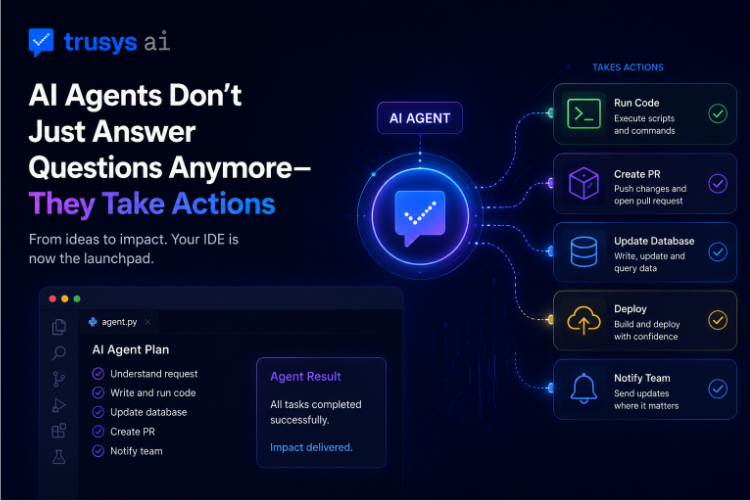
AI Agents Don’t Just Answer Questions Anymore—They Take Actions

A year ago, most AI applications in production did one thing: they answered questions. You asked, the model responded, and whatever happened next was up to a human.
That’s no longer true for a growing share of enterprise AI. Today’s AI agents send emails, execute SQL queries, provision cloud infrastructure, retrieve documents from internal knowledge bases, create Jira tickets, deploy code, call third-party APIs, trigger approval workflows, and in some architectures, coordinate with other agents to complete multi-step tasks — often without a human in the loop for every step.
That’s a shift in what AI is inside the enterprise: from an assistant that produces text to an operator that produces outcomes. It changes the risk conversation completely. A chatbot that gives a wrong answer creates a bad experience. An agent that takes a wrong action — sends the wrong email, queries the wrong table, approves the wrong transaction — creates an incident.
When AI starts taking actions instead of simply generating text, governance stops being a nice-to-have layered on top of the model. It becomes a prerequisite for letting the agent operate at all.
From Chatbots to Autonomous AI Agents
The evolution didn’t happen in one step. It moved through recognizable generations, each expanding what the AI was allowed to touch.
Generation 1: FAQ bots and knowledge assistants. Scripted or lightly-tuned systems that answered a bounded set of questions from a fixed knowledge source. Low risk, because there was nothing for them to act on.
Generation 2: RAG systems and enterprise search. Retrieval-augmented systems that pulled from live internal documents to answer more open-ended questions. Risk expanded to include what got retrieved and surfaced, but the agent still wasn’t acting on the enterprise’s behalf.
Generation 3: AI copilots. Assistants embedded in a workflow — drafting code, summarizing a ticket, suggesting a reply — but typically requiring a human to review and execute the final action.
Generation 4: Autonomous AI agents and multi-agent systems. Systems that call tools directly, take actions with real consequences, and increasingly coordinate with other agents to complete a task without a human approving every intermediate step. Model Context Protocol (MCP) has accelerated this by standardizing how an agent discovers and calls external tools, making it dramatically easier to wire an agent into email, databases, ticketing systems, and cloud infrastructure.
The defining feature of Generation 4 isn’t intelligence — it’s reach. These agents interact directly with enterprise systems, not just with users.
Every Tool Call Is a Security Decision
Once an agent can call tools, every one of those calls is effectively a permission being exercised. A connected agent can send emails on the company’s behalf, modify production databases, read from or write to a CRM, query HR systems containing sensitive employee data, post in Slack channels, execute code, provision cloud resources, trigger payments, and open support tickets — the standard integration surface for a modern enterprise agent.
That makes “what tools can this agent call, and under what conditions” one of the largest sources of enterprise AI risk, not a configuration detail. A permission granted once tends to stay granted long after the use case that justified it has changed.
A few concepts from traditional security carry over directly, and matter more here than they did for static software:
- Least privilege — an agent should hold only the permissions its current task requires, not the permissions it might need someday
- Scoped permissions — access should be scoped to specific systems, actions, and data ranges rather than granted broadly
- Approval workflows — high-consequence actions (payments, production changes, external communications) should require a human checkpoint, even in an otherwise autonomous flow
- Access boundaries — clear limits on what an agent can reach, enforced at the tool-call layer, not just assumed from a system prompt
Enforcing these well requires visibility into what tools an agent actually has access to and how it’s using them — not just what it was configured to have when it launched.
New Risks Introduced by Action-Oriented AI
Giving a model the ability to act introduces failure modes that don’t exist for a text-only system.
Prompt injection. An attacker embeds instructions in content the agent processes — an email, a web page, a document, a calendar invite — to redirect its behavior. It’s one of the most consequential agentic-AI risks precisely because it doesn’t require compromising the model, only the content it reads.
Tool abuse. An agent uses a legitimate permission for an unintended purpose — using email access not to communicate but to exfiltrate data elsewhere.
Data exfiltration. Sensitive information — customer PII, financial data, proprietary code — leaks out through an agent’s normal channel of operation, often without the underlying task appearing to have failed.
Over-permissioned agents. Access rights accumulate beyond what a current function requires, widening the blast radius of any single compromise.
Hallucinated actions. The agent executes a workflow based on an incorrect or fabricated understanding of the task — not just a wrong answer, but a real, consequential step taken on that wrong answer.
Agent drift. Behavior validated at launch shifts gradually as memory accumulates or context evolves, with decision patterns changing without any single triggering event.
Multi-agent cascading failures. Where agents delegate to or coordinate with others, one compromised agent’s bad output can become another agent’s trusted input, propagating the failure across the system.
Security researchers increasingly organize these risks using frameworks purpose-built for agentic systems — the OWASP Top 10 for Agentic Applications and MITRE ATLAS both now include categories addressing tool misuse, memory poisoning, and cross-agent trust exploitation.
Governance Must Move Closer to Developers
For a long time, the default model for AI governance was retrospective: build the feature, ship it, let a security or compliance review catch problems weeks later. That doesn’t hold up for action-oriented agents, where the risk is created the moment permissions and instructions are defined, not discovered later in a review meeting.
Shifting left means developers validate tool permissions, agent policies, guardrails, prompt safety, model evaluations, red-team results, and risk scores while building the agent, not after it’s deployed. A developer should be able to answer “what can this agent do, and has that been tested” before merging a change — not weeks after users start relying on it. This isn’t about adding bureaucracy; it’s about making sure the person who defines an agent’s capabilities also sees the consequences of getting that definition wrong, while it’s still cheap to fix.
Continuous Monitoring After Deployment
Shifting governance left doesn’t make monitoring after deployment optional — it makes it necessary for different reasons. Pre-deployment testing validates behavior against known scenarios; production traffic introduces inputs and adversarial content that no pre-launch test suite fully anticipates.
Effective runtime monitoring for agents tracks tool usage patterns, policy violations, prompt injection attempts, agent failures, hallucinations, unexpected workflow paths, changes in risk scores, and compliance-relevant events that need to be logged for audit purposes. The goal isn’t just to flag that something went wrong — it’s to trace a full lineage of what triggered the action, what data the agent touched, which tools it called, and what it produced, so a failure can be traced to its root cause.
Runtime visibility matters because an agent’s risk profile isn’t fixed at launch. It shifts as memory accumulates, as the tools it calls change, and as attackers learn what content reliably manipulates it — the risk that development-time testing, by definition, can’t see yet.
Why AI Guardrails Matter More Than Ever
Guardrails are best understood as operational safety controls that run continuously — not a static rulebook applied once. For action-oriented agents, that means enforcing controls at multiple points: output validation, policy enforcement, tool restrictions on what an agent can call and under what conditions, human approval gates for high-consequence actions, context validation to check the agent’s understanding is grounded in real data rather than injected content, PII protection, content filtering, and risk thresholds that can automatically pause or escalate activity when behavior crosses a defined line.
Guardrails that only check a prompt or response at the text level miss what’s specific to agents — the tool call itself, and the action it triggers, need their own checks.
How Trusys Helps Secure Enterprise AI Agents
Trusys approaches agent governance as a continuous discipline rather than a one-time gate, spanning evaluation, security testing, and runtime oversight throughout an agent’s lifecycle.
TruEval evaluates how agents actually behave — tool use, multi-turn reasoning, memory persistence, sub-agent delegation, and inter-agent collaboration — against a large library of behavioral metrics, not just prompt-level benchmarks.
TruScout red-teams agents the way they’re actually attacked: through poisoned emails, hostile web pages, malicious documents, and compromised tool responses, mapped to the OWASP Top 10 for Agentic Applications, MITRE ATLAS, and other agent-specific threat taxonomies.
TruGuard enforces inline policy at the agent’s input, output, and action layers — blocking injection attempts, enforcing data-classification rules, and restricting unauthorized tool use without requiring changes to the agent’s code.
Argus, Trusys’s autonomous governance layer, ties these together — running evaluations, watching production traces, executing red-team campaigns, and enforcing policy continuously, surfacing what needs a human decision rather than a dashboard of raw data.
For teams building agents inside Cursor, Claude Code, or Google Antigravity, Trusys MCP connects the IDE to this same evaluation, red-teaming, and guardrail infrastructure via Model Context Protocol.
None of this makes an agent’s actions risk-free — no testing regime can promise that. It gives teams continuous, evidence-backed visibility into what their agents are actually doing, instead of relying on the assumption that they’re doing what was intended.
Best Practices for Building Action-Oriented AI
- Follow least-privilege principles for every tool an agent can call
- Continuously evaluate agent outputs against defined behavioral baselines, not just launch-time benchmarks
- Test adversarial prompts and tool-misuse scenarios before and after deployment
- Monitor agent behavior in production for drift, policy violations, and unexpected tool use
- Review tool permissions on a recurring schedule, not only when an agent is first built
- Implement human approval workflows for high-consequence or irreversible actions
- Validate that guardrails are actually catching what they’re designed to catch, not just deployed
- Log all agent actions with enough context to reconstruct what happened during an incident review
- Run red-team exercises regularly, not as a one-time pre-launch gate
- Build governance checks into CI/CD pipelines so they run automatically with every change
AI Agents Are Operators Now — Govern Them Like It
AI agents no longer just answer questions. They take actions, access enterprise systems, make decisions, and execute workflows that used to require a human at every step — the same expanded capability that makes them valuable also makes ungoverned agents a liability.
Organizations that get this right treat AI governance as continuous, developer-friendly, and built into every stage of the AI lifecycle, not a compliance checkbox applied after the fact. As agentic AI becomes the default way enterprises build with AI, the organizations that treat governance as a core engineering discipline — on the same footing as testing and security review for any other production system — will be the ones still trusted to let their agents act autonomously.
If you’re building agents that call tools, access enterprise data, or take real actions on your organization’s behalf, explore how Trusys helps engineering and security teams test, monitor, and govern AI agents continuously, or book a demo to see it against your own agent stack.
FAQs
What makes AI agents riskier than traditional chatbots?
Traditional chatbots generate text that a human reviews before anything happens. AI agents call tools and take actions directly — sending emails, modifying data, triggering workflows — which means a failure produces a real-world consequence rather than just an incorrect response.
What is prompt injection, and why does it matter more for AI agents?
Prompt injection is when an attacker embeds hidden instructions in content the AI processes — an email, document, or web page — to hijack its behavior. It matters more for agents because the hijacked behavior isn’t just a bad response; it’s an unauthorized action taken with the agent’s real permissions.
How is agent governance different from traditional AI model monitoring?
Traditional AI monitoring typically tracks model outputs — accuracy, latency, drift in text generation. Agent governance has to additionally cover tool permissions, action-level audit trails, multi-turn and multi-agent behavior, and runtime enforcement at the point an action is about to be taken, not just when text is generated.
Should AI agent governance happen before or after deployment?
Both, and continuously. Shift-left practices catch permission and policy issues during development, when they’re cheapest to fix. Runtime monitoring is still necessary after deployment because production traffic introduces inputs and adversarial content that pre-launch testing can’t fully anticipate.
What frameworks are used to assess AI agent security risks?
The OWASP Top 10 for Agentic Applications and MITRE ATLAS are two of the most widely referenced frameworks for classifying agent-specific risks, including tool misuse, memory and retrieval poisoning, and cross-agent trust exploitation.