Could Your Walsall Workplace Cope Until an Ambulance Arrives?

A colleague drops beside a racking aisle, a toddler visiting reception starts choking on a grape, or a forklift driver suffers a deep cut while the rest of the team freezes for a second too long.
For employers reviewing first aid training in Walsall, the practical question is not simply who holds a certificate, but whether the right people can act before professional help arrives. The sections below focus on collapse, choking, seizures and serious injury, with clear priorities for those early decisions.
The Critical Window for Workplace Emergencies
The first minutes after a serious incident are often spent inside your own premises, not in an ambulance bay. In Walsall, that might mean a unit on an industrial estate, a school office, a warehouse, a shop floor or a care setting waiting for responders to find the right entrance. The key sequence is simple but demanding: recognise what has happened, make the area safe, get help moving, start first aid, and keep information ready for the handover.
The Health and Safety (First-Aid) Regulations 1981 require employers to provide adequate and appropriate first-aid arrangements for employees. HSE guidance on first aid at work makes clear that this depends on the hazards, workforce size, work patterns and access to medical services.
The first four minutes matter because they are usually controlled by bystanders and colleagues. In sudden collapse, early recognition of abnormal breathing can trigger CPR and AED use. In choking, a fast distinction between mild and severe airway obstruction changes the response.
A useful emergency call-out plan is specific enough to survive stress. It should say who meets responders, which gate or door to use, where the AED is kept, and who brings the first aid kit.
Good planning also avoids a false sense of order. Real incidents spill across roles, radios fail, and the trained person may be on lunch or working off-site. That is why the next step is to look at what the first person on scene should do when a collapse suggests cardiac arrest.
Managing Sudden Collapse and Cardiac Arrest
A collapsed person on a warehouse floor draws eyes before it draws action: a pallet truck is still moving, a machine is running, and the nearest colleague is trying to work out whether the casualty is breathing. This is the moment for a simple pattern rather than debate. The first aider’s task is to protect themselves, assess responsiveness and breathing, get emergency help moving, start compressions if needed, and bring an AED into use quickly.
Assessing the Scene Safely
The DRAB cheque gives a usable order under pressure: Danger, Response, Airway, Breathing. Danger comes first because a second casualty helps nobody. Look for traffic, electricity, chemicals, falling stock, aggressive behaviour or machinery that has not been isolated. Then cheque response by speaking loudly and gently shaking the shoulders, before opening the airway and checking breathing for no more than 10 seconds.
- Danger: stop, look and remove obvious hazards if safe.
- Response: speak clearly and cheque for any purposeful movement.
- Airway: open the airway with a head tilt and chin lift. If you suspect a spinal injury, do this carefully while minimising head movement.
- Breathing: look, listen and feel for normal breathing.
Occasional gasps are not normal breathing. NHS CPR guidance treats an unresponsive person who is not breathing normally as needing CPR. In a workplace, give clear jobs by name: “Asha, get the AED,” and “Tom, meet the ambulance at goods-in.” Named instructions reduce the bystander pause.
The Importance of Early Chest Compressions
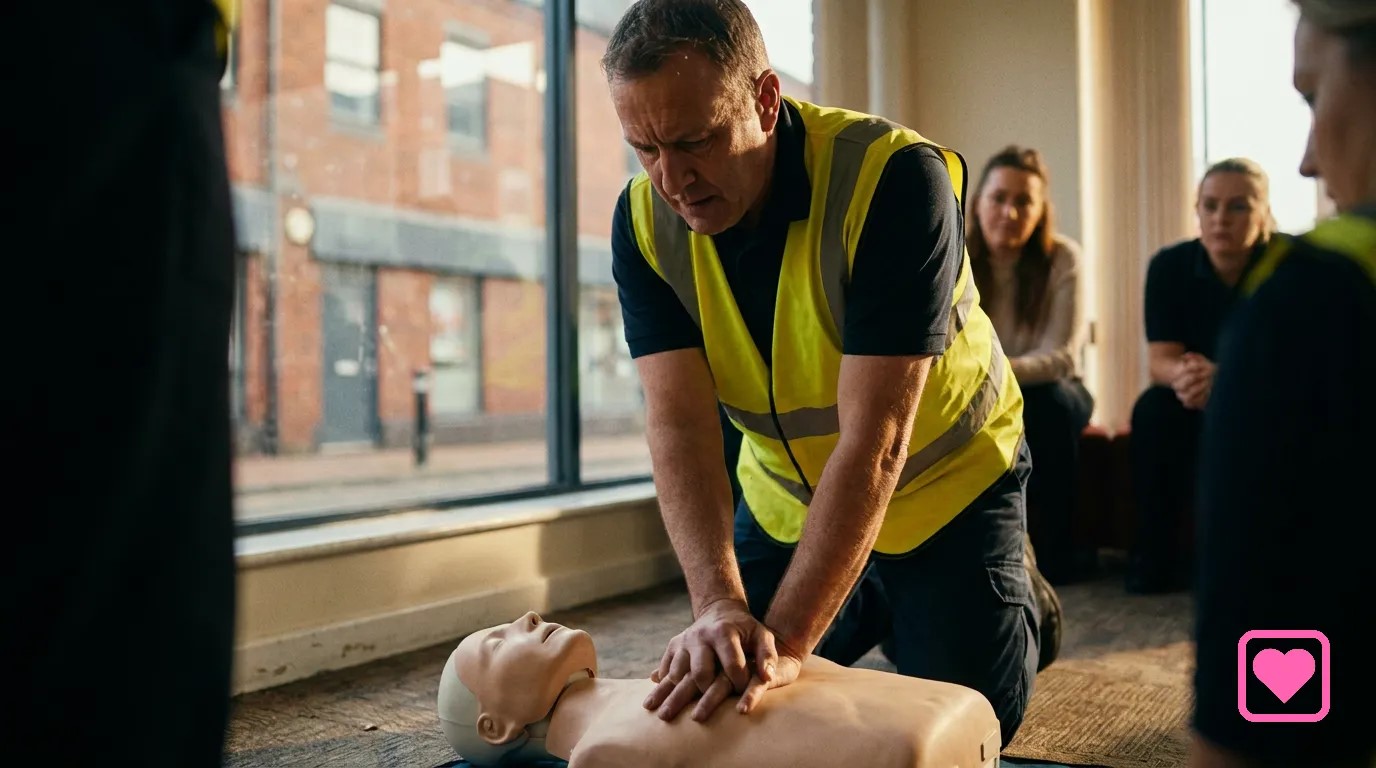
Chest compressions keep blood moving to the brain and heart when the casualty’s own circulation has failed. Place the heel of one hand in the centre of the chest, put the other hand on top, keep your arms straight and press down firmly. NHS guidance gives a rhythm of 100 to 120 compressions per minute, allowing the chest to rise fully between compressions.
If you are trained and willing to give rescue breaths, use 30 compressions followed by 2 breaths. If not, continue hands-only CPR until help takes over or the person shows clear signs of life. Swap compressors if another trained person is present, because fatigue quickly reduces depth and rhythm.
Using an Automated External Defibrillator (AED)
An AED is designed for public and workplace use, not just for clinicians. Once switched on, it gives voice prompts and visual cues. Expose and dry the chest if needed, attach the pads as shown on the diagrams, and make sure nobody is touching the casualty while the device analyses the heart rhythm. If a shock is advised, the AED will tell you when to press the button.
After any shock, restart CPR immediately unless the device instructs otherwise. If no shock is advised, keep doing CPR and follow the prompts. Pads should usually stay in place until ambulance clinicians take over. This same calm sequencing is useful in other high-stress incidents too, especially when breathing or airway problems are at the centre of the emergency.
Immediate Action for Choking and Seizures
A choking incident can turn a noisy break room silent in seconds, while a seizure can make a whole office crowd around and do the wrong thing with good intentions. Both situations need quick recognition and restraint from bystanders. The aim is not to perform every possible intervention, but to choose the right first action: encourage coughing if air is moving, use a clear choking sequence if it is not, and protect a person having a seizure without holding them down.
The Back Blow and Abdominal Thrust Sequence
Mild choking means the person can cough, speak or breathe. Encourage them to keep coughing and watch closely. Severe choking is different: they may be unable to speak, may clutch their throat, become silent or turn blue. For an adult or child over one year, give up to 5 sharp back blows between the shoulder blades, checking after each one whether the blockage has cleared.
- Stand slightly behind and to one side.
- Support the chest with one hand and lean the person forward.
- Deliver back blows with the heel of your hand.
- If needed, give up to 5 abdominal thrusts.
- Alternate 5 back blows and 5 thrusts. If the obstruction is not cleared after these, call 999 immediately and continue the cycle until the blockage clears or the person becomes unresponsive.
Abdominal thrusts are delivered by standing behind the person, placing a clenched fist above the navel and pulling sharply inwards and upwards. They are not used for babies under one year. Anyone who has received abdominal thrusts should be medically assessed afterwards, because internal injury is possible even if they seem well.
Supporting a Person During a Seizure
During a seizure, the safest first action is usually to clear space, not to restrain movement. Move chairs, tools, hot drinks and sharp objects away. Put something soft under the head if available, loosen tight clothing around the neck, and note the time the seizure started. Do not put anything in the person’s mouth, and do not try to give food, drink or tablets while they are convulsing.
When the seizure stops, cheque breathing and place the person in the recovery position if they are breathing normally and there is no reason to suspect major injury. Stay with them as they recover, because confusion and tiredness are common.
Serious Injury and Haemorrhage Control
A major bleed changes the room quickly: people see blood, panic rises, and the casualty may deteriorate before anyone has finished looking for gloves. The priority is to stop or slow the bleeding while help is on the way. Use direct pressure with a dressing, clean cloth or gloved hand if available, and keep pressure constant. If blood soaks through, add more material on top rather than repeatedly removing the original dressing.
Catastrophic bleeding from a limb may need firmer measures, especially where machinery, tools or vehicle movement are involved. Apply pressure directly over the wound, or as close as possible if an object is embedded. Do not pull out embedded objects, as they may be reducing the bleeding.
Shock is a real risk after serious injury, particularly with heavy blood loss, burns or crushing injuries. If the casualty is breathing and it is safe, help them lie down, keep them still and protect them from cold using a coat or blanket. Do not give food or drink.
Emergency information should be gathered while first aid continues. Send someone to meet responders, unlock gates, move vehicles if safe, and prepare details about the injury, time of incident, hazards and treatment given.
Serious injury also creates legal and operational follow-up. Some incidents may require reporting under RIDDOR, depending on what happened and the injury outcome. The first concern remains the casualty, but accurate notes, preserved scene details and witness names help managers review what failed and prevent the same incident happening again.
First Aid Training Walsall: Strengthening Your Safety Protocols
After reading through collapse, choking, seizures and major bleeding, the common thread is clear: the first person on scene needs a short, practised sequence rather than a long policy folder. A Walsall employer should review its first-aid needs assessment against real site hazards, including machinery, lone working, visitors, shift patterns, travel between sites and how quickly responders can reach the exact location. The plan should match the building, not a generic template.
Reading can set priorities, but it cannot recreate the feel of kneeling beside a casualty, pushing to the right CPR depth, fitting AED pads or applying firm pressure to a bleeding wound. First aid kits also need the same practical attention: visible locations, intact seals, in-date contents, gloves, dressings and clear signage.
If your designated first aiders need practical rehearsal for these first few minutes, Brity® can help you work through Emergency First Aid at Work or First Aid at Work training in a structured, hands-on setting.